Developmental Foundations: Why the Early Years Matter

A child’s development is much more than reaching individual milestones. Learning to sit, crawl, walk, communicate, regulate emotions, pay attention and eventually engage in learning at school are all part of a much bigger developmental picture.
At Brainshape, we explore development as an interconnected developmental picture, recognising that foundational abilities and higher-level functions influence and interact with one another as children grow.
Looking at development through a bottom-up lens
One of the central ideas explored at Brainshape is looking at development through a bottom-up lens.
A newborn does not begin life with a fully developed nervous system. Different areas and systems develop and mature over time, while continually interacting with one another.
The Brainshape Development Pathway provides a framework for exploring these areas:
Primitive reflexes → muscle tone and symmetry → postural and core stability → vestibular function → eye control → autonomic regulation → cortical integration → social engagement and executive function
These areas interact and develop alongside one another, with every child following their own pathway.
The Brainshape Foundational Development framework
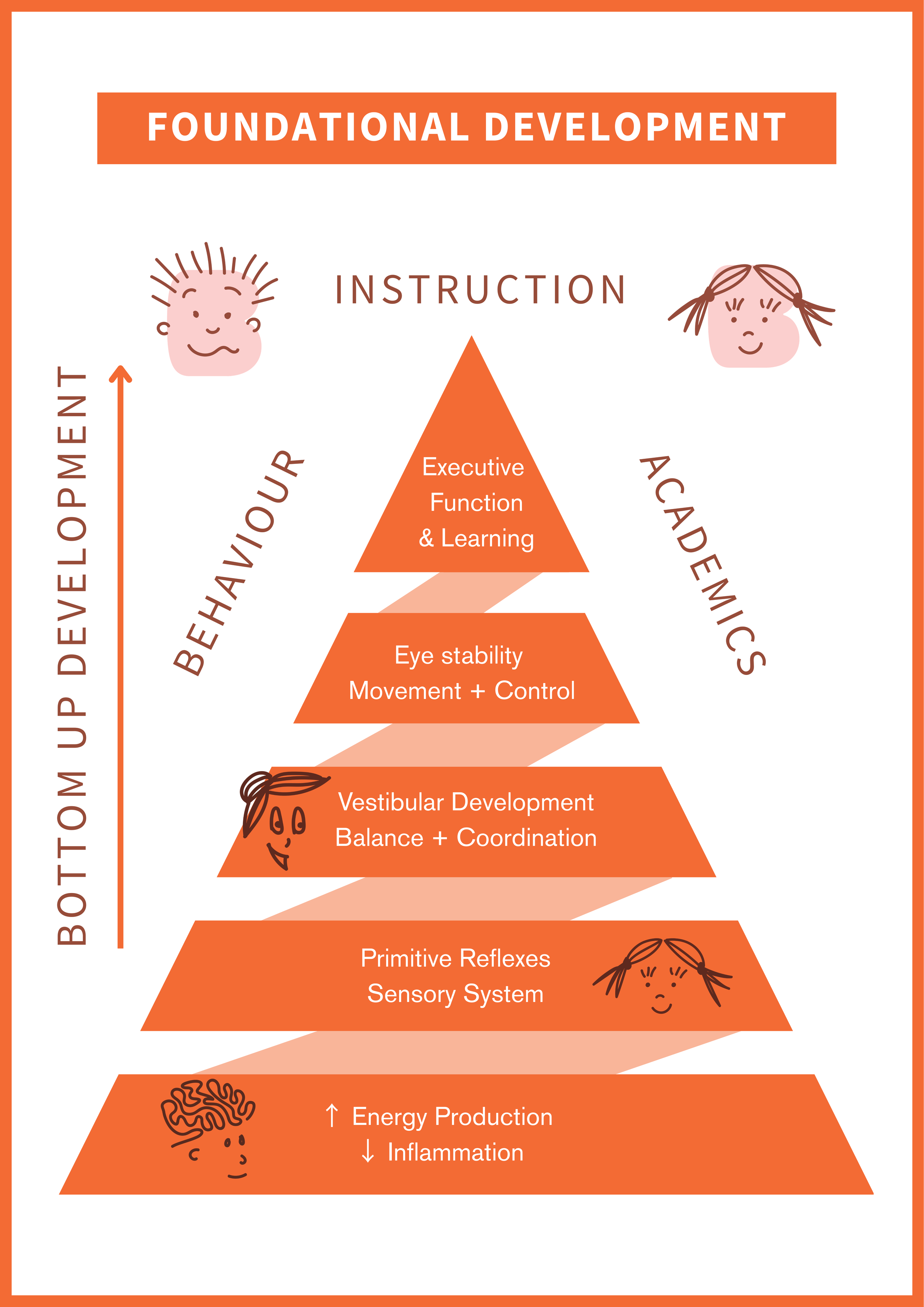
The Brainshape Foundational Development framework — a visual guide used to explore different areas within a child’s wider developmental picture.
Movement is part of brain development
Movement isn't simply something children do to burn energy. During early childhood, movement provides the developing brain with important sensory information.
Rolling, reaching, crawling, balancing and walking all give the nervous system opportunities to receive information from the body and environment.
As children develop, these experiences are associated with the development of body awareness, balance, coordination and other movement skills.
This is why movement can be an important part of understanding a child’s broader developmental picture.
The cerebellum: an important part of the developmental picture
The cerebellum is an important part of the developmental picture. It plays a significant role in balance, movement and coordination and communicates with many other networks throughout the brain.
Skills such as balance, muscle tone, posture, coordination and eye movements are not isolated abilities. They form part of a wider network of communication between the brain and body.
Understanding these relationships can provide useful information when considering a child’s overall development.
From movement to learning
As children develop, increasingly complex skills emerge through the interaction of many different systems.
For example, effective eye control is important for activities such as reading. Body awareness and balance are involved in coordinated movement, while regulation can support a child’s ability to remain calm and engaged.
Later-developing executive functions support skills such as inhibition, planning and managing thoughts and actions.
These relationships do not mean that one developmental difference automatically causes a learning difficulty. Rather, they highlight why considering a child’s foundational development can provide additional information when trying to understand their individual strengths and areas for support.
Regulation and the nervous system
Another important part of developmental foundations is the nervous system’s ability to move between different states.
The autonomic nervous system includes the sympathetic system, associated with the body’s fight-or-flight response, and the parasympathetic system, associated with rest and recovery.
A child’s ability to regulate develops over time and is influenced by their developing nervous system and their environment.
Children are not expected to have the same level of emotional regulation as adults. A two-year-old, for example, is still developing the ability to manage emotions and inhibit impulses.
As children grow, they generally develop greater capacity for attention, emotional regulation and executive function.
Why look at the foundations?
When a child is experiencing difficulties with areas such as coordination, attention, learning, emotional regulation or social interaction, it can be tempting to focus only on the visible behaviour.
The Brainshape approach encourages us to consider the wider developmental picture:
How are primitive reflexes presenting?
How is their muscle tone and symmetry?
How are they managing balance and coordination?
How aware are they of their body in space?
How are their eyes moving and coordinating?
How is their nervous system responding to stress?
These questions can help create a broader picture of how the brain and body are working together.
The developing brain is adaptable: Neuroplasticity
The developing brain is continually responding to experiences and sensory information. The brain can change at different ages, with development being particularly adaptable during childhood.
This concept of neuroplasticity provides an important message of hope for families: development is not necessarily a fixed path.
However, adaptability does not guarantee a particular outcome. Every child’s development is individual, and many factors influence how development progresses.
At Brainshape, the goal is to understand the individual child, identify areas where their foundational development may need support, and use targeted movement and sensory experiences as part of a broader neurodevelopmental approach
Strong foundations support growing potential
Children are constantly developing physically, emotionally, socially and cognitively.
By understanding the foundations beneath these skills, parents and practitioners can gain a deeper appreciation of how interconnected development really is.
Because every child has their own starting point — and understanding that starting point can help families find a clearer way forward.