
When we think about a baby’s development, we often focus on the milestones we can easily see — rolling, sitting, crawling, walking and talking.
However, underneath these milestones is another important aspect of development happening inside the nervous system: primitive reflexes. At Brainshape, primitive reflexes are one part of understanding the foundations of a child’s neurological development.
What are primitive reflexes?
Primitive reflexes are involuntary movement patterns that are present from birth. They are mediated through lower levels of the nervous system, including the brainstem. These reflexes support babies to survive, move and begin interacting with their environment before higher areas of the brain are fully developed.
For example, a newborn baby needs to be able to find and feed from the breast. The rooting and sucking reflexes help make this possible. At birth, the motor cortex is still developing, so these automatic responses provide important movement patterns during the early months of life.
As the brain and nervous system develop, primitive reflexes typically become less prominent as voluntary movement and motor control develop.
What ATNR-related movement can look like.
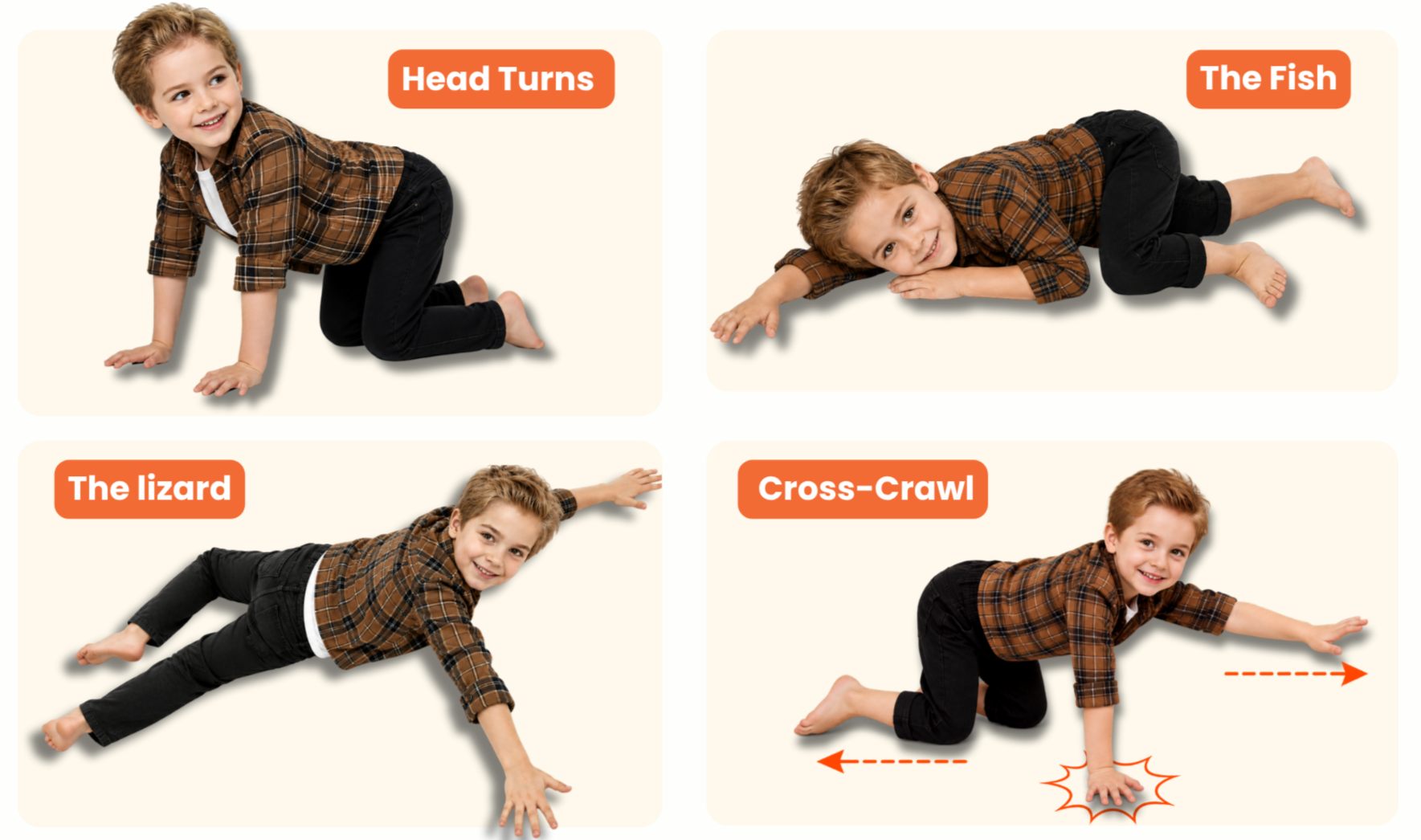
These images illustrate examples of movement activities that may be used within an individual program. Activities should be selected and guided by a suitably qualified clinician.
Why do primitive reflexes matter?
Primitive reflexes form part of the broader picture of early neurological development. As these early responses become less prominent, children develop increasingly sophisticated movement and motor skills.
Within the Brainshape approach, primitive reflexes are considered alongside areas such as:
Muscle tone and symmetry
Postural and core stability
Balance and coordination
Vestibular function
Eye movement and control
Autonomic regulation
Higher-level neurological functions
Rather than viewing development as a simple ladder, these systems can be understood as interacting and developing alongside one another.
What if primitive reflexes remain active?
Primitive reflexes typically become less prominent during infancy as voluntary movement and motor control develop. The timing can vary, and the presence of a reflex on its own does not explain a child’s learning, behavioural or developmental presentation.
During a broader clinical assessment, a practitioner may consider primitive reflex responses alongside factors such as movement, coordination, balance, sensory processing, developmental history and everyday function.
One example is the Asymmetrical Tonic Neck Reflex (ATNR) — sometimes called the “fencer” reflex.
When a baby turns their head, the arm and leg on the face side extend while the opposite limbs bend. This is a normal early-life response that supports early movement and body awareness. As voluntary movement develops, the response usually becomes less prominent.
Another familiar example is the Moro, or startle, reflex, which can be seen when a baby responds to a sudden sound, movement or change in position.
These reflexes are an important part of early development. The goal is not for them to simply “disappear”, but for early reflexive responses to become appropriately integrated as the nervous system develops.
Every child is different
A child’s development is influenced by many interacting factors, and no single reflex, behaviour or developmental feature should be considered in isolation.
If you have questions or concerns about your child’s development, speak with an appropriately qualified health professional.
At Brainshape, primitive reflexes may be considered as part of a child’s wider developmental picture. Assessment considers the child’s individual history, movement, sensory experiences, daily function and family priorities before recommendations are made.
Other age-appropriate movement exercises recommended by a healthcare professional
The suitability of these activities depends on the individual's age, development and clinical presentation.